I spend a lot of time on LinkedIn. It is a part of my marketing and sales strategy and a platform I use for business and pleasure. According to a study done by Hootsuite, “LinkedIn is most popular with older users, with 46-55 year olds most likely using the site.” Given LinkedIn touts they are a network with over 830 million members, there are many of you, like me, who have more time spent in their career than have time left in their career.
Now, I am not trying to depress you or make you melancholy. Whatever your age, you should have a time futured mindset. A time management program ought to include elements that permit periods of planning and reflection of time that is to come. Nevertheless, the older one becomes, the time emphasis should be more on personal and less on business (even if the future is only seen as business).
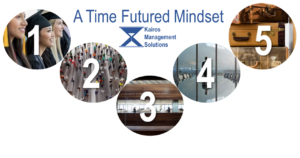
Based on hundreds of participants in the Time Management Analysis (TMA), Retirement Time Analysis (RTA) and Work-life Balance (WLB) assessments, a long term and time management future-based program could look something like this.

What the chart does not show is a sizeable number struggle with the balance between relationships and career in a portion of or all through their life. Additionally, various individuals compartmentalize their time management to only a sector (usually professional). Consider your time futured mindset based on the following:
Group 1
Usually representing a very exciting time in life, group 1 thinks about the future in much shorter lengths. Time management here should be about establishing potential patterns and learning ways of preparation. Integrate both personal and professional now and it will benefit life in the groups to come.
Group 2
Still enjoying the benefits of youth and energy, group 2 introduces a lot of complexity into their lives. The ability to devote the right time to personal versus professional goals can create priority conflicts. A time futured mindset should be mapping out and executing career goals. In addition, defining the lifestyle you want to lead, grooms people to maintain a healthy work-life balance (the expertise to focus on personal or professional, switching back and forth when needed).
Group 3
Typically the personal and professional life is more predictable because everyone is older and hopefully wiser. Routines are, to a greater extent, better understood and mapped out. Income is at its peak. The group 3 challenge can represent a life that has too much activity, too much planned stuff. There is not a time futured mindset because the time focus needs to be on the present. Begin to envision a post career, or a career modified reality where a life of more personal time will be available.
Group 4
I am personally in this group. For many, this is the pinnacle of the career where you have the greatest demands of your time because of high responsibilities. This is now the opportunity to develop a future time mindset that provides a pathway to a career understanding as well as a robust personal life with goals and purpose. This is a wonderful time to decide how to give back, share, and be flexible.
Group 5
Let this be the most rewarding time of life. Not as the end of a career accomplishment, but a time futured life that offers purpose, meaning, accomplishment, and design. Whether you choose to devote a small or large portion of your time to professional pursuits, integrate it into the personal so you approach the time to come with one well laid out style.
“A time management program ought to include elements that permit periods of planning and reflection of time that is to come.”
My journey through 4 of the 5 groups (so far!) are filled with stories of success, screw-ups, and opportunity. I have managed my time well, and not so well. At times, I was too concerned about the present, dwelled on the past, and neglected the possibilities of the future. However, I am excited to be where I am at today and have a time futured mindset full of potential and promise.
Should you want to explore your time management strategy, consider the following tools to get you started. In each, you will receive a free summary report highlighting areas of emphasis.
Group 1: Time Management Analysis (TMA)
Group 2: Time Management Analysis (TMA), Leadership Assessment Tool (LAT), Work-Life Balance Assessment (WLB)
Group 3: Time Management Analysis (TMA), Leadership Assessment Tool (LAT), Work-Life Balance Assessment (WLB), Retirement Time Analysis (RTA)
Group 4: Time Management Analysis (TMA), Work-Life Balance Assessment (WLB), Retirement Time Analysis (RTA)
Group 5: Retirement Time Analysis (RTA)
Dave Buck is the Chief Time Keeper of Kairos Management Solutions.
Learn about your time management opportunities by taking and getting a free Time Management Analysis (TMA) summary report. Schedule an appointment with Dave Buck to discuss a full-time management improvement program for individuals, teams, and companies.